The Surprising Link between Dark Circles and Leaky Gut Syndrome

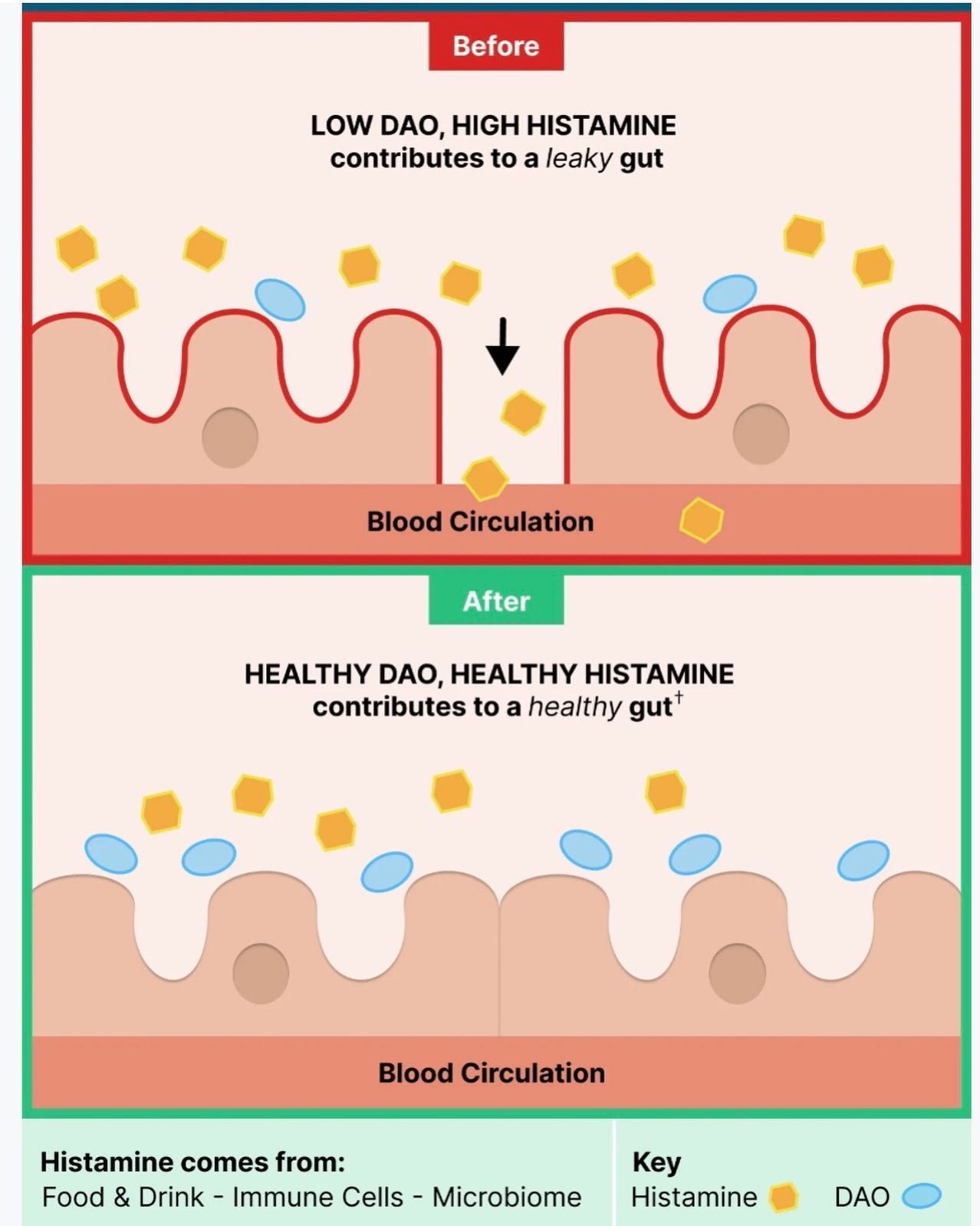
Dark circles under the eyes can be caused by a variety of factors, including genetics, lack of sleep, and allergies. However, one possible cause is an imbalance in histamine levels in the body. Histamine is a chemical that is released by the immune system in response to allergens, it is also released by gut bacteria in your microbiome. An excess of histamine can cause inflammation and swelling, it can also cause your gut to become leaky.


When your gut is "leaky," it means that the lining of your intestines is damaged and allows harmful substances to pass through. This can lead to a cascade of problems, as the histamine can than leak out of the gut and into the bloodstream. Once in the bloodstream, the histamine can travel throughout the body, affecting various organs and systems, including the brain, skin, nose, eyes, heart, bladder, uterus, placenta, developing baby, and breast milk. This is why consuming foods or drinks that contain histamine can cause symptoms throughout the body within seconds to minutes.


These signs may mean that you have High Histamine:

  • Diarrhea*
  • Bloating*
  • Abdominal discomfort*
  • Reflux*
  • Food Intolerance*
  • Leaky Gut*
  • Skin Issues
  • Migraines and headaches
  • Irritability
  • Difficulty falling asleep
  • Joint Pain Musculoskeletal or connective tissue pain (fibromyalgia)
  • Chronic Fatigue
  • Estrogen Dominance
  • Painful Menstruation
  • Hypotension
  • Tachycardia
  • Rapid Heart Rate
  • Hypotension
  • Dizziness
  • Trouble regulating body temperature
  • Trouble Sleeping


*The gut is usually the biggest reason why people experience histamine intolerance. You can find out if your microbiome, or your gut immune system, is overwhelming your DAO enzyme in two ways.


  1. Have your doctor or functional medicine practitioner test for high histamine with a Diamine Oxidase (DAO) Level test. This is analytical test which is carried out in the laboratory using the ELISA method to measure the level of the DAO enzyme in the blood.
  2. A quick home test:

Away from food, on an empty stomach take a histamine blocker supplement. You can create a free account with my online store here to order.

After swallowing the capsule, it opens up and begins digesting histamine right away in your small intestine. If there’s a lot of histamine in your small intestine, you’ll likely begin feeling better.

If there’s not much histamine in your gut, you won’t notice much of a difference.


What does this tell you?

  1. Do I have a lot of high-histamine producing bacteria living in my gut? Yes or No.
  2. Is my gut immune system producing a lot of histamine? Yes or No.


With this information, you know if your histamine symptoms are gut related or not.

If not, then you know you’re reacting to something in your environment like mold, an infection, or your histamine pathway is dirty for other reasons.


Addressing the root cause of high histamine levels in the gut is crucial for healing leaky gut and preventing further health issues.


By maintaining healthy histamine levels in the gut, you may be able to reduce the appearance of dark circles and improve overall skin health.


There are many ways to heal with functional medicine. You can work with Heidi via our group functional medicine program or one on one. To find out if this is the right path for your health journey you are welcome to schedule a free health discovery session with our office.

Don't Miss Out On More!

Heidi Toy FNTP

I help people all over the world heal by identifying and treating the root cause of their body imbalances. Through diet and nutrition, I guide them towards wholeness and balanced lives.

Heidi Toy Functional Medicine Blog

By Heidi Toy May 11, 2026
Alpha-gal syndrome symptoms, red meat allergy, tick-borne allergy, delayed food allergy, alpha-gal test
By Heidi Toy May 6, 2026
How Silicone Breast Implants May Contribute to Autoimmune Responses and Health Issues
heavy metal toxins affect autoimmunity
By Heidi Toy April 29, 2026
What you should know about heavy metal detox if you have an autoimmune disease.
By Heidi Toy April 21, 2026
When it comes to autoimmune conditions, many of my clients are eager to find answers about the foods that could be triggering their symptoms. They often think, "If I just avoid certain foods, I’ll feel better." But, what they might not realize is that food combinations can play a huge role in causing autoimmune flare-ups, even when the individual ingredients don’t show antibodies on their own. It’s a tricky and often frustrating area of functional medicine, but understanding it is key to healing. Here's what you need to know. Understanding Food Protein Reactions Let’s start with the basics. In a perfect world, food sensitivities and allergies are pretty straightforward. You eat a food, your body reacts, and you know exactly what caused the problem. Unfortunately, with autoimmune disease, the story is more complex. As a functional medicine practitioner trained under Dr. Datis Kharrazian, I don’t just look at individual foods—I look at immune response. And food proteins can behave very differently when combined. You may have a test that shows no antibodies for specific foods, think chicken, potatoes, or broccoli. But when those foods are cooked together in a meal, something changes. The proteins in those foods could combine in a way that causes your immune system to recognize them as a threat, triggering an autoimmune flare-up. The reason for this is cross-reactivity, where similar amino acid sequences in different food proteins can cause your immune system to confuse one food for another. This phenomenon is real, and it's something I see often in my practice. Just because a food doesn’t show a reaction on its own doesn’t mean it won’t cause issues when combined with others. The Role of Cross-Reactivity Cross-reactivity happens when your immune system mistakes one protein for another because they share a similar amino acid sequence. For example, if you react to salmon, you might also react to other types of fish due to similarities in their protein structures. This concept is why combining foods like certain grains, dairy, and legumes might trigger reactions in some individuals, even if they’ve tested negative for antibodies to those foods. Let’s look at a real-world example. Imagine eating a gluten-free Kung Pao chicken that’s free of contamination. You’d think that meal would be perfectly fine, right? But if that combination of chicken, spices, and vegetables triggers a reaction, it could be because of how the proteins in those foods interact once combined. Why You Should Pay Attention to Food Combinations In the context of autoimmune disease, where your immune system is already overactive, food reactions can be subtle and unpredictable. So, the next time you’re tempted to dismiss a food intolerance because a test didn’t flag it, think again. It’s not just about the individual foods—it’s about how they interact in your body. You need to pay close attention to how different food combinations make you feel. It’s easy to get caught up in thinking that food sensitivities only apply to the big culprits: gluten, dairy, or soy. But as an autoimmune patient, it’s essential to understand that your body might be reacting to the interaction of multiple foods. So while a test might show that chicken and broccoli are “safe” on their own, eating them together in a casserole could trigger symptoms. The N=1 Approach to Autoimmunity and Food Sensitivities Here’s the bottom line: There is no one-size-fits-all approach when it comes to food and autoimmunity. As I always tell my clients, you are the expert on your own body. Testing can give us a great starting point, but it’s your unique experience that helps us narrow in on what’s truly causing your flare-ups. This is why food sensitivity testing—while helpful—is just one part of the puzzle. You have to be keenly aware of your body’s reactions and the foods you’re combining, even if the individual ingredients test negative for antibodies. Don’t ignore what your body is telling you. If something doesn’t feel right after a meal, listen to it, and make adjustments accordingly. The Takeaway If you're struggling with autoimmune symptoms and haven't been paying attention to food combinations, it’s time to start. While food testing is an invaluable tool, it doesn’t give us the full picture. You may need to do some trial and error with food combinations to uncover what’s really triggering your symptoms. It’s also important to remember that autoimmune healing is complex and individualized. You are an N=1, which means your treatment plan should be tailored to you. Don’t be afraid to advocate for your health, and work with a functional medicine practitioner who can help guide you through the nuances of food reactions and autoimmune management. Are you struggling to identify food sensitivities or autoimmune triggers? Let's work together to find a personalized solution that addresses your unique needs. You are welcome to start with a Free Health Discovery Session.
By Heidi Toy October 14, 2025
For many of us, our experience with food comes with some sort of baggage. Maybe you eat to cope with stress, anxiety or depression. Maybe you’ve grown up with value-words placed on food such as “junk” and “healthy,” and told you couldn’t eat the “good stuff” (brownies and ice cream) until you finished the “yucky stuff” (broccoli and lettuce). Or, even more serious, maybe you or a loved one has struggled or is struggling with an eating disorder. Food is amazing and life-giving. It can be used as a means to celebrate, socialize, or simply just provide fuel for the body. Our relationship with food shouldn’t be a difficult one, it should be an enjoyable one. A way to get to that healthy place in your relationship is to practice mindful eating. Mindfulness is a Buddhist concept of mediation that can help you recognize emotions and physical sensations present. Through mindful eating, you can learn to truly pay attention to your experiences, cravings and physical cues. The basics of mindful eating are: Eat slowly, without distraction. If you are eating with others, take a least five minutes at the start of the meal to enjoy the food on your plate before engaging in discussion. Pay attention to your body--are you still hungry, or are you getting full? Learn to distinguish between cravings and true hunger. Use all your senses when you sit down to a meal. Make an effort to notice how the food looks, smells, tastes, feels in your mouth, and sounds when you chew. Appreciate your food, who has prepared it (even if it’s you--what an accomplishment!), and where it comes from.  Being mindful of your experience will help you slow down while eating. This can prevent overindulgence by making the act of eating intentional instead of automatic. It will also help you become aware of triggers that make you want to eat (are you truly hungry at 9pm every night when you sit down to watch that Netflix show, or do you just pour yourself a bowl of Chex Mix because that’s what you always do?). Knowing your triggers can give you time to process what’s truly going on and the ability to react properly.
By Heidi Toy October 14, 2025
Are you struggling with fatigue, frequent infections, or other health issues? It could be a sign of glutathione deficiency. Learn more here.
By Heidi Toy October 2, 2025
Here are the essential functional medicine steps for Fifth Disease! If your child comes home with bright red cheeks that look like they’ve been “slapped,” chances are they may have fifth disease, also known as erythema infectiosum. This mild viral illness, caused by parvovirus B19, is common in kids and often spreads t
By Heidi Toy September 14, 2025
Successfully healing Adrenal Fatigue requires a holistic approach focussed on fixing the root cause of your problems and supporting your body through the healing process. This means we are going beyond just temporary symptom relief. We want you to return to vibrant health so you can get back to the active and healthy lifestyle that Adrenal Fatigue is holding you back from. (Adrenal Fatigue is more accurately known as HPA-D. Check out my blog HPA-D vs Adrenal Fatigue to learn more.)Again, we would be completing further testing to get to the root cause of your issues, but this protocol is a great starting point for healing. We focus on five essential areas for fast and long-term healing.
By Heidi Toy August 14, 2025
Change up where/how you purchase your food.
By Heidi Toy August 4, 2025
How Food Sensitivities Fuel Autoimmune Flares—And What to Do About It
More Posts